
Are you coming to Prague and want to enjoy it in a less touristy way? Away from the stereotypical routes and crowded streets? Welcome, you landed on the right page. Here is one of the itineraries I have created for one of my clients. You can either follow it yourself or, if you are interested, you can send me a tour request and I will show you around personally.

Who is writing this blog for you?
Hello, my name is Dana and I am a Prague local, born and raised here, just like my parents.
I run a tiny business called Prague Behind The Scenes. The company consists of only me:-) I guide and design various off-the-beaten-path tours for my clients. It’s my full-time job, and this year, 2026, marks my 11th season. With my services, I try to support sustainable and respectful tourism in Prague.
I am also helping you navigate Prague even without meeting me on the tour👋🙏🙂Since 2015, I have been writing this blog. Completely free of charge, with no hidden extra paid content behind a paywall. On a completely “clean” website free from affiliate links, pop-up ads, and commission-based collaborations.
I am proud to have created a simple, yet unbiased platform for all curious travelers who wish to explore Prague in a less touristy way. If it´s you, please feel free to drop me a line at dana@praguebehindthescenes.com

Prague less touristy. How?
Just like many other capitals in Europe, Prague is also suffering from overtourism. Especially some of its hotspots: Charles Bridge, Old Town Square, Astronomical Clock, Jewish Quarter, or Prague Castle. And especially on the weekends and Christmas. The only way to avoid the crowds is to wake up early and come before the mayhem starts.
Or simply just go anytime, somehow survive, and then find peace in many of Prague’s back alleys. That’s where the real, authentic charm of Prague opens up for you. Away from large tour groups, touristy restaurants, cheesy souvenir shops, and influencers making their content.

Prague tour itinerary – please feel free to follow my steps
This is a short, condensed version of an itinerary I have created for one of my US clients. It’s a walking tour that focuses on the Prague Lesser Town.
The starting point for us was the Alchymist Prague Castle Suites on Sněmovní Street – a hotel where my clients were accommodated. It’s actually located in one of my most favorite parts of the Lesser Town. It’s absolutely charming and usually has zero tourists there.
It’s in super close proximity to the Czech Senate and the House of Representatives, both just a 1-minute walk away. But you will barely recognize it as there are almost no security measures or barriers. Both institutions are situated in stunning massive, historical palaces. However, the location is very peaceful.

What is Prague Lesser Town?
Lesser Town is the area under Prague Castle. The Old Town is on the other side of the Vltava river. The Lesser Town as it looks now, was built after the greatest and most devastating fire in Prague – in 1541. So, most of the buildings you will see around you were built in Renaissance and Baroque styles on the former, older Gothic settlement.
We know that people were living here already in the 9th century. Or to be more precise, people settled here already in the Neolithic times, but let’s stick to only some “recent” history:-)

The hotel where my clients were staying is a charming Baroque building with some Art Nouveau additions. Back in the 17th century, it was home to one of the best Czech painters (the so-called Czech Rembrandt), Petr Brandl. What a personality he was! Womanizer, sinner, alcoholic, party guy, and full of debts.
But thanks to his unique painting skills, he still received prestigious assignments from monasteries, cloisters, and noble families. If you want to see some of his works, make sure to visit the nearby Church of Our Lady Victorious. It’s one of the most sacred places in our country, housing the famous statue of the Infant Jesus of Prague verenated all around the world.
Now, when you know that some of the church altar paintings were created by the enfant terrible, hedonist, and bohemian Petr Brandl, you’ll undoubtedly step into the church with a knowing smile on your face. 😊 Enjoy the moment of having a little secret that others have no clue about.

1. New Pope and Prague Lesser Town
Yes, the newly elected Pope, Leo XIV. (Robert Francis Prevost), has been to Lesser Town at least ten times for a visit. Not as a tourist (maybe just a little bit) but mostly as a member of the Augustinian order.
The Augustinian monastery is located in Lesser Town, and the adjacent St. Thomas Church belongs to it, too. Robert Francis Prevost, still as Cardinal based in Rome, always drove his car himself to Prague to spend some time here managing the reconstruction works of the local Augustinian properties.
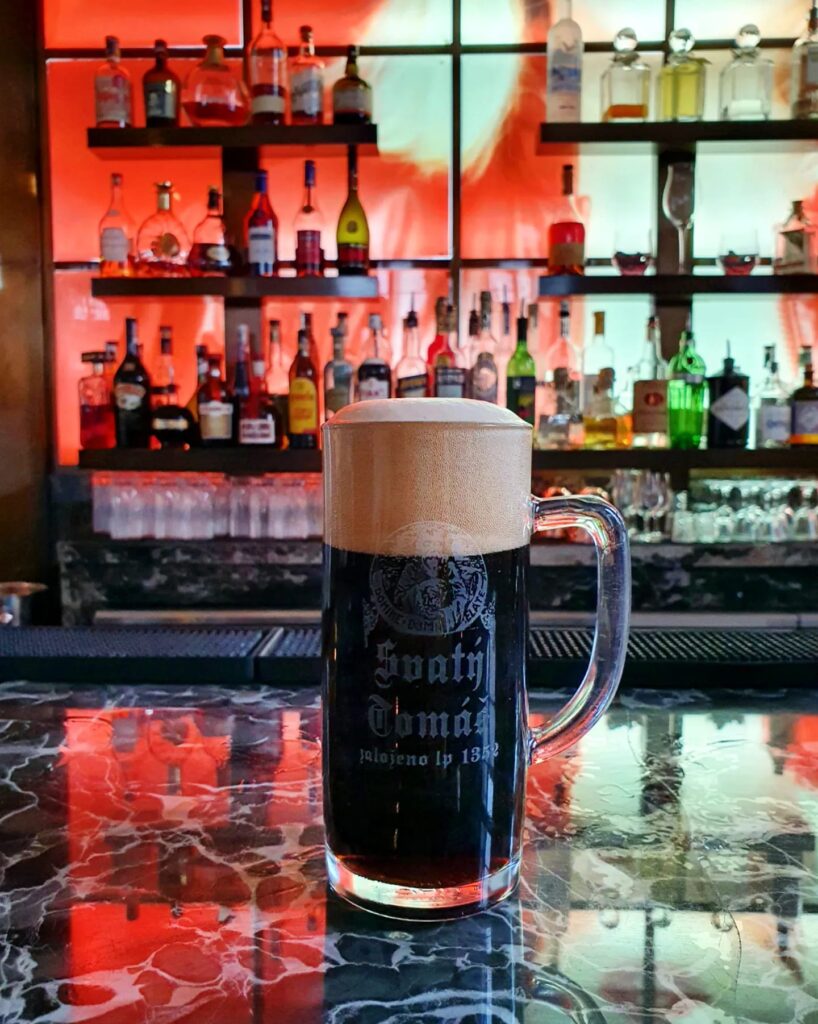
He had even planned another visit in 2025 to attend a confirmation ceremony for the local Augustinians, but his election as Pope has made him significantly busier. He is also a big fan of Czech beer. If you are thirsty, try the Augistinian beer called St. Thomas (Sv. Tomáš) dark beer. It´s served in the Refectory bar (former dining room of the brothers) and also in the beer hall of The Augustine hotel.
2. Hand written street names
We started our tour on Sněmovní Street. When you take a closer look, you will see the street name on the red metal board. But look what is under it. Something is written right on the facade. In Czech and in German.
These bilingual names date back to the 18th century, when the streets were first given official titles and registered. They were painted directly onto the walls of the buildings. The German name is even styled in a unique font known as Schwabacher.
So, why were these names bilingual? During the 18th century, German was an official language in the Czech lands, as we were under the rule of the Austrian Habsburgs. You can see many of such handwritten streets names in Lesser Town and they are very pretty.

What is also interesting? That until the 18th century Prague houses didn´t have numbers (people were often iliterate) so instead of numbers they were using names. Each house had a name and a little picture, sculpture or relief on the facade: House at the Golden wheel, House at the Golden Swan, House at Three Fiddles…This helped with orientation. On Nerudova street in Lesser Town you will find the highest concentration of the well preserved house signs.

3. Look up the hill now! Castle!
Yes, from this spot you will also perfectly see Prague Castle – oh well, just a little part of it as Prague Castle is the biggest castle in the world. But look now at the light green building. It’s incorporated into the castle complex and it’s called Rosenberg Palace.
Its function back in those times was really impressive. It served as a home to unmarried poor noblewomen. Since the 18th century until 1918, it served as such a social care facility for the nobility.
Officially called the Institute for Noblewomen, this institute was founded by Empress Maria Theresa to look after the poor, unfortunate noblewomen who didn’t find a partner for life. The institute provided them with a small apartment, three meals a day, pocket money, and various activities. The institute was run by abbesses, but it didn’t serve as a monastery.
The ladies were free to leave, get married, or stay there until their death. This institution was extremely prestigious and raised the status of the ladies living there. They even received a dowry in case they got married.

4. House of Representatives and embassies
When walking toward the Lesser Town Square (Malostranské náměstí), we will pass the majestic palace of the House of Representatives, as well as the embassy of Albania and consulate of Monaco (After Vatican, Monaco is the 2nd smallest state in the world). I always wonder how big their embassy might be.

In front of the British embassy, you will discover a bust of Winston Churchill. This hidden sculpture was crafted by Franta Bělský, a Czech artist known for being the only sculptor to depict four generations of the British Royal Family: the Queen Mother, Prince Andrew (that´s the one involved in Epstein files), Queen Elizabeth II, and Prince William (at the age of 3 years).

Franta Belsky´s second wife was a Czech artist Irena Sedlecka, who, beside many others, created the famous sculpture of Freddie Mercury standing in Switzerland by the Lake Geneva. This sculpture also appeared on the last Queen´s album Made in Heaven.
On the same street leading to the British Embassy you will also find a cult Prague pub U Hrocha (At the Hippo). It is a typical small place with grumpy server, sticky tables but excellent beer. You may encounter here a great colorful mix of locals, tourists, and politicians from the nearby embassies or government institutions.

5. 15th century pharmacy
At the intersection of Malostranské náměstí and Zámecká Street lies Prague’s oldest and still-operating pharmacy, known as Fragner’s Pharmacy or the Pharmacy at the Black Eagle. Locals are familiar with both names. If you look above the entrance, you will see a large black eagle. This pharmacy dates back to the 15th century.

During World War II, under Nazi occupation, Czech scientists working for this pharmaceutical company, successfully developed the first version of Czech penicillin, known as Mykoin BF 510 (the BF stands for initials of the pharmacy owner, Benjamin Fragner). This version was fully comparable in quality with its British competitors (Dr. Flemming, the Scottish physicial received a Nobel Price for it).
The Czech scientists bravely concealed their invention from the Nazis, claiming they were merely working on a substance to kill mold in army storehouses, while in reality, the antibiotics they produced were saving lives.

The interior is almost like a step back in time with wooden furniture and a counter (tara). And a chadelier. Beside regular medications, they also specialize in preparation “magistraliter”, custom-made products made on the spot. You will get them in these retro pharmaceutical jars (see the picture below).
If you want a nice Prague souvenir (and practical), get their cult product with a history since 1866 – Original Prague medicinal cream (Pražská mast). It’s good for hangnails, small festering wounds, scratches, insect bites…
Reminder!!! Guys, please don’t go there as if it’s some touristy attraction and please don’t take pictures, it’s really an operating place!

6. Plaque column – another place related to health
And now look in the middle of the parking space. There is a beautiful column. We call it a plaque column of the Holy Trinity (Jesus Christ, God the Father, and the Holy Spirit represented by the dove).
But why is it named a plaque column? Historically, many countries and cities faced devastating plague epidemics. In gratitude for their survival, local communities commissioned the construction of plague columns dedicated to the Virgin Mary, the Holy Trinity or other patron saints agains plaque, as a symbol of thankfulness for protecting from death.
The columns were often situated in the most important, biggest squares. Because such places around the column were later used for services during the next epidemics when people were not allowed to gather indoors, in churches.

7. Schools on the Lesser town Square
Maybe you think that the building around the square are hotels or some other government institutions….but no, the biggest palaces on the square are schools – faculties of local universities. The lovely light blue building on the right is Academy of performing arts – music and dance faculty and the building next to the church is faculty of Physics and mathematics of the Charles University.
8. St. Nicholas Church in Lesser Town
This church dominating the square is probably the most impressive one in Prague (my subjective opinion). Unfortunately, there is a paid entry, but I think it’s worth it. Because many Prague churches are closed during the day, and this one stays open all day long. So if you want to see one really impressive high Baroque church, this is the one.
It took nearly 100 years to complete it since Leopold I., Holy Roman Emperor, tapped the corner stone in 1673. There are also two floors inside: the ground floor and the upper balcony, from where you can see the ceiling frescoes and take lovely pictures of the entire interior. People usually don’t know about the chance to go up there.
Are you familiar with the movie Van Helsing? It’s a bit of a “B” Hollywood vampire film. Some scenes were filmed in this church. The church had to be consecrated again after the production left.

9. Bell Tower on the Lesser Town Square
This bell tower behind the church cupola is also open to the public (yep, another entry fee), and from the top, there are absolutely stunning 360° views of Prague Castle, Lesser Town, Strahov Monastery, and the Old Town. For many years, this tower served as a fire watchman’s tower. Fire watchman was actually a very important job!
During an era when open flames were common for cooking and craftsmen, fires could easily escalate, as evidenced by the catastrophic blaze in 1541. The fire watchmen were observing the neighborhood, and in the event of a fire, they would place a flag in the direction of the fire (at night they used lanterns). They rang the bells and shouted from the tower to inform the community. The watchmen even had apartments inside the tower. You can still see them while walking up to the top.

During communism, the very top of the tower (above the dial) was used as a spying spot of the secret police. The room also still exists. it’s codename was “Kajka”, and you will reach it after a good cardio workout to the top. Their duty was to observe Western embassies located nearby (US, West Germany…).

10. Three trees people never notice
Only a short walk from the Lesser Town Square will take us to the Church of Our Lady under a Chain. The church itself is only open during services or special occasions, but the garden is always open during the day time.
People usually just take a sneak peek and leave. But there is so much to explore! The trees growing on your left-hand side might have some special meaning if you take a closer look.
The first tree is the spiny poncirus trifoliata, a type of citrus tree from which Christ’s crown of thorns was allegedly made.

In the middle is Cercis siliquastrum, known as the Judas tree in English. This is the type of tree Judas allegedly hanged himself from.
The third tree, right by the entrance to the church, is a fig tree. It is a symbol of abundance, peace, and safety. Fig leaves were also used by Adam and Eve to cover their intimate parts after they were sent away from the Garden of Eden).
11. Quick stop at Charles Bridge
I know, I know, you say now that Charles Bridge is no hidden gem and definitely not off the beaten path. But don’t worry, you will soon see why I am taking you here.
We will only go to the entrance of the bridge because I would like to show you a little fun detail there. Let’s go to find the statue of St. Cosmas and Damian, martyrs and patron saints of medical science (that’s why they are carrying the medical/pharmacy jars and also a palm leaf, a symbol of martyrs).
Can you see the little golden inscription in the cartouche below the statues? So this is the so-called “chronogram.” Such a hidden message from the past. Read the Latin sentence that says: “Iesu Christo orbis medico” (To Jesus Christ, healer of the world). Some of the letters are written in capitals, right? Even in the middle of the sentence. These are Roman numerals. Count them all together. Voilá – 1709, a year when this sculpture was created. ✨

12. Church of our Lady Victorious
And here we are again in front of a very important church. It’s maybe not that impressive from the outside, but it houses one very important statue: the famous Baby Jesus of Prague (Infant Jesus of Prague). It’s a tiny, 47 cm tall statue made of wood and wax. It depicts Jesus at the age of approximately 4 years.
The sculpture was made in the 16th century in Spain and brought to Prague as a wedding gift. The family later donated the statue to this church. But why is it so famous? It’s believed that the statue has miraculous powers and helps people with basically anything you pray for. But of course, most people come here with prayers for a child or for recovering from illness.

But for example, in the ’80s, there was also the famous writer Paulo Coelho who prayed to become a successful writer. And here we go, The Alchemist was published, leading to over 150 million copies sold!
Note, while you are standing in front of the Baby Jesus altar – there are such little tiles surrounding him. These are so called “ex vota”. Words of thank you, words of gratitute from various people all over the world whose prayers have been fulfilled. In appreciation, they contributed donations to the church and their tiles and names are now placed close to the Baby Jesus.

Interesting thing about the Baby Jesus is that the nuns are changing his clothes approximately once a month, according to the liturgical season. They are also changing the colors of the clothes because various colors represent different liturgical times: a white robe is for Christmas and Easter, red, the color of blood, is worn on the anniversaries of various martyrs, green is the most common color and is worn on the ordinary days, and purple is worn, for example, during Advent or Lent. Only on the Christmas day the statue stays “naked”.
The Baby Jesus has really an extensive wardrobe, with over 300 different robes. People from all over the world send the robes as gifts. There is one also from Paulo Coelho and one from Christians in Mexico. This model is equipped with a little sombrero (that’s my favorite!)
The most beautiful and rarest robes you can see in a little room at the top of the church. Yes, the sombrero is there, too! This little exhibition of “the best of Baby Jesus’ wardrobe” is free of charge. And the church as well.
Fun fact: A small statue of the Baby Jesus of Prague is traditionally required at every Irish wedding, as it is believed it secures a good weather.

13. How about a riverfront views?
Now let´s walk toward the Kampa island. From the riverfront you will enjoy fantastic views over the Charles Bridge, Old Town, and even the New Town (note: New Town is not new, it was founded already in the 14th century.
But in the middle of the river, you will also see an island. It’s called Střelecký Island (Shooters / Archers Island in English). It’s a natural river island, and the river Vltava was flowing around it already in the 12th century when the island was used as a garden and was owned by the Maltese Knights.
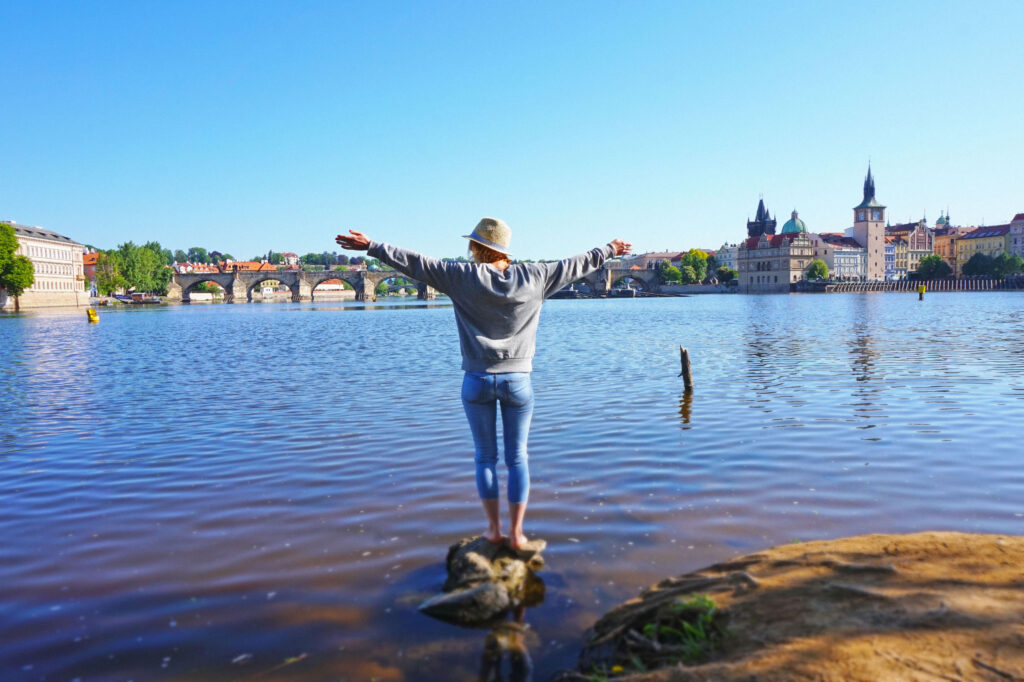
In the 14th century, it served as a training shooting range, hence the name. Today, the island serves as a chill-out place for locals and also the local animal stars: nutria, aka the fake beaver. Cute, not aggressive, and very friendly buddies. However, they are an invasive species, so we shouldn’t feed them. But it’s quite hard to resist. Sometimes they get close to you, stand up, and beg for food. And they are very good at it.

14. National Theatre
From the island you will enjoy another amazing and very original views! Especially over the National Theatre (standing in the New Town). That’s our most important theatre scene, first opened in 1881. It was the very first Czech theatre performing in the Czech language.
The main reason why the National Theatre was built was to support Czech cultural life, Czech national identity within the Austro-Hungarian Empire, and especially to protect our language. The official language here was German, Czech was only second. The National Theatre was a theatre where all the plays were performed in the Czech language. The building of the theatre was funded by public money donations.
Unfortunately, shortly after the opening in 1881, the theatre burned down. Again, some workers were using open fire, and this disaster happened. Yeah, Prague, the city of fires and floods. Fortunately, people were generous again and collected the funds even faster than during the first fundraising. In two years, the theatre was reopened and is still standing to this day.

Interesting Facts
- The theatre features 22 cornerstones sourced from various locations and pilgrimage sites across our country.
- One cornerstone even comes from Chicago, sent by the Czech community living there, though it arrived a bit late, taking this piece of marble three years to reach Prague.
- Yes, the rooftop is real gold.
Time to sit down and rest our feet
Guys, thank you for reading. I hope this itinerary was inspiring for you and that you enjoyed your walk. Now it’s time to enjoy a drink and rest a bit. In the area of the National Theatre, I can highly recommend my favorite hidden café called Coffee and Riot (fantastic carrot cake and hot chocolate). Or if you prefer something a bit more lively, then Café Louvre is great, too. I particularly enjoy their delightful five o’clock tea ritual, complete with tasty snacks. Cheers!!!

Dana, your guide for intimate small group tours and experiences in Prague.
Did you find my local tips helpful? You can treat me to a virtual coffee! I truly appreciate your kind support and feedback.

Where to next?
3 hidden gems of Prague food scenes still undiscovered by a mass tourism
How to read (and understand) the Astronomical Clock in Prague?